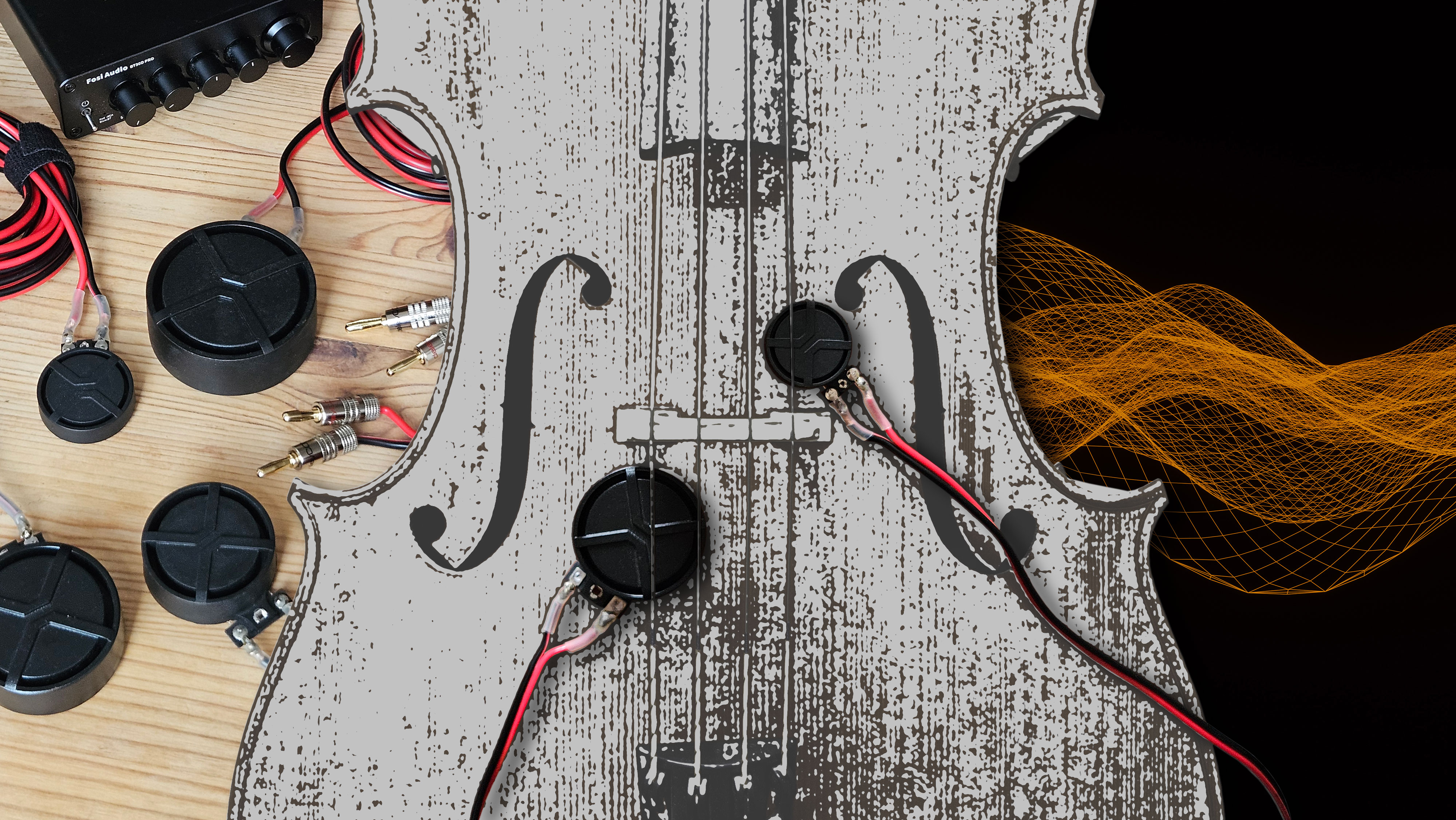
I originally started looking for a way to perform pieces for two cellos on my own. Many guitarists use a looper pedal to perform their own compositions live. A tap of the foot starts recording a few bars. Another tap ends the recording and immediately plays it back as a loop, allowing them to play over it.
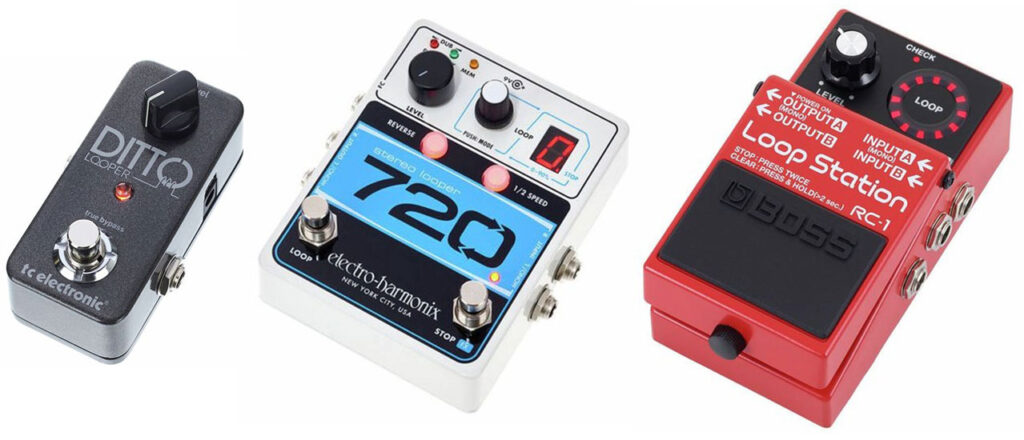
Loopers come in all shapes, sizes and price ranges, from simple pedals with just the essentials to more elaborate loop stations with built-in drum sounds and effects. If you’re curious, here’s a selection:
https://www.thomannmusic.com/en-de/looper.html
One cellist using loopers who immediately comes to mind is Anne Müller. I saw her perform at Funkhaus in Berlin in 2018, during a lovely afternoon of concerts presented by Erased Tapes. Here’s a video of her piece Solo? Repeat!:
It’s beautiful music. But live looping works best when the music is built around recurring phrases, which can be layered into songs or soundscapes. That approach doesn’t suit my compositions particularly well.
In my case, it would make more sense to have the other parts played by a computer running an Ableton Live set. One thing I love about small classical concerts, though, is the intimacy of hearing unamplified music coming directly from the instruments. I would like to preserve that in small performances, rather than have the sound become more “anonymous” through a PA system. That also means more equipment to set up. The scene I had in mind was simply this: me, my instrument, a chair and a power socket.
At some point, I remembered exciters. We often used them during my work as a media technician at Eidotech GmbH, for example to introduce sound discreetly into exhibitions without visible loudspeakers.
A conventional loudspeaker moves a diaphragm, which sets the surrounding air in motion and creates sound waves. An exciter instead makes the surface it is attached to vibrate. Those vibrations travel through the material, and the vibrating surface radiates sound into the air.
A cello works in a related way. The bow sets the strings in motion, and their vibrations are transmitted through the bridge to the body of the instrument. My idea was to use exciters as an alternative source of vibration, driving the wooden body of the cello directly.
Choosing the exciters
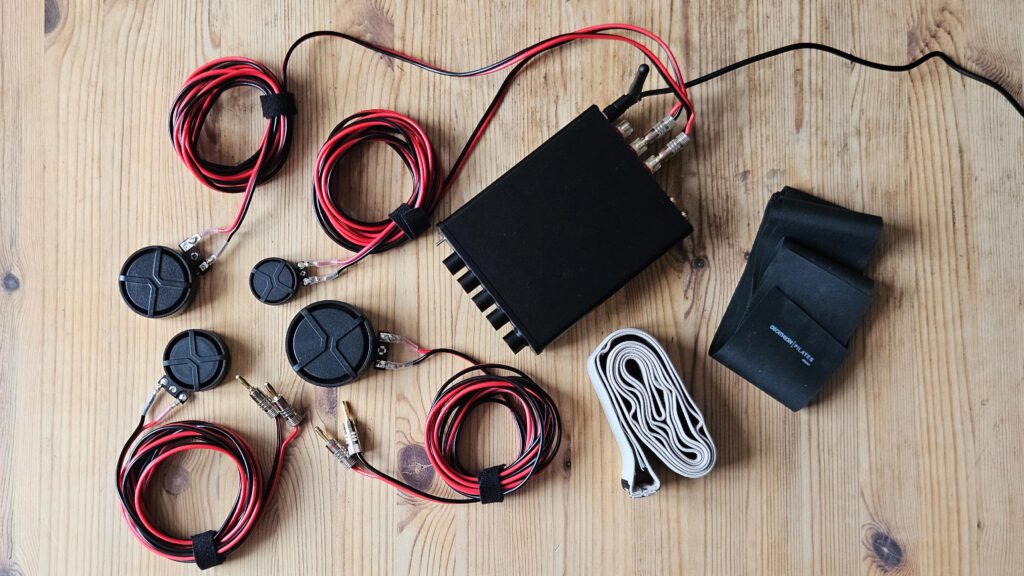
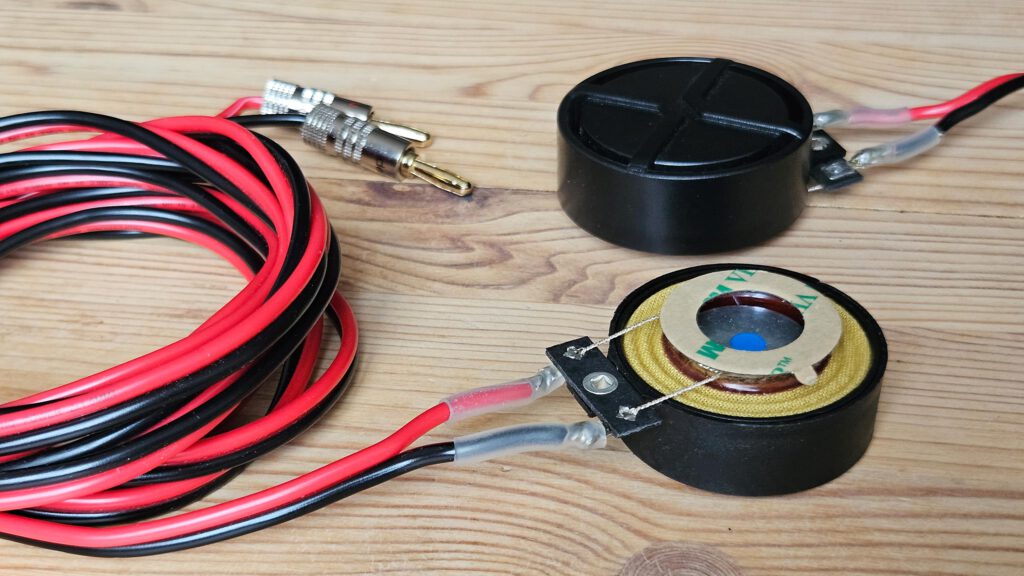
After a little research, I bought a few exciters of different sizes to experiment with. Their advertised frequency ranges are:
- Xcite Xtreme XTB40 (25 Hz –1 kHz)
- Xcite Xtreme XT32 (35 Hz- 17 kHz)
- Xcite Xtreme XT25 (40 Hz –19 kHz)
- Xcite Xtreme XT19 (75 Hz –20 kHz)
The cello range illustrated below extends from C2 to approximately G6 (without using harmonics as a playing technique), corresponding to fundamental frequencies of around 65 to 1,568 Hz.
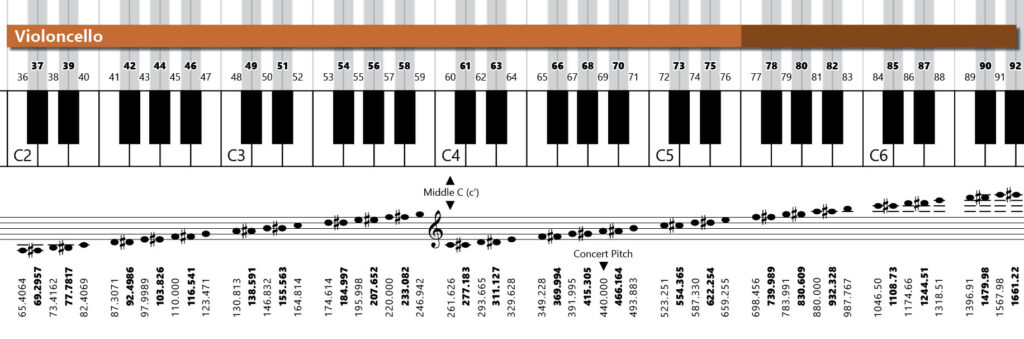
At first glance, the XT32 and XT25 both seem well suited to this range, comfortably covering those fundamental frequencies on paper. They were therefore natural candidates for a setup with just one exciter. In my tests, however, the XT32 lacked a little brilliance in the upper frequencies, giving the sound an almost con sordino, or muted, quality. The XT25 sounded brighter, but was rather weak in the bass.
How can that be, when both apparently cover the frequencies of all the notes shown above? Part of the answer is that a note contains much more than its fundamental frequency. An illustration I created for a workshop I taught on overtones, timbre and the relationships between notes in chords helps make this clearer.
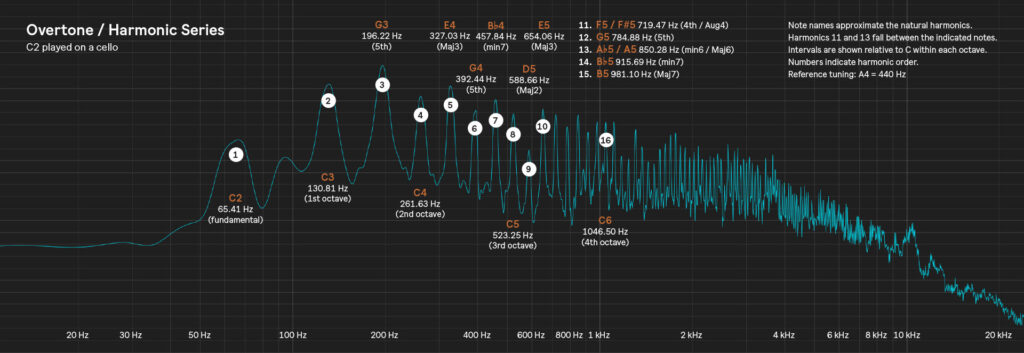
The image shows the spectrum of C2 played on a cello. Its fundamental is clearly visible at around 65 Hz, but there are many more peaks to the right. These are its harmonic overtones, which sound above the fundamental at intervals such as octaves, fifths and thirds.
Their relative strengths help give the note its particular timbre. Many acoustic instruments produce sounds with a similar structure. Electronic sounds can contain rich harmonic spectra too, but a pure sine wave provides a useful contrast: a sine wave at 65 Hz would appear as just one peak in an ideal spectrum.
The fundamental frequencies of the notes alone are therefore not enough to determine which exciter to choose. And the advertised frequency limits don’t tell the whole story either. They don’t show how evenly or strongly an exciter reproduces the frequencies within that range, especially once it is attached to a cello. The exciter, its position, the way it is mounted and the resonances of the instrument all contribute to the result.
To cut a long story short: after plenty of listening and experimenting, I now mostly use the XTB40 bass exciter together with the XT25. I sometimes use the XT19 instead when I want a brighter, more detailed sound. Overall, though, I find that the XT25 blends more naturally with the XTB40.
Positioning the exciters
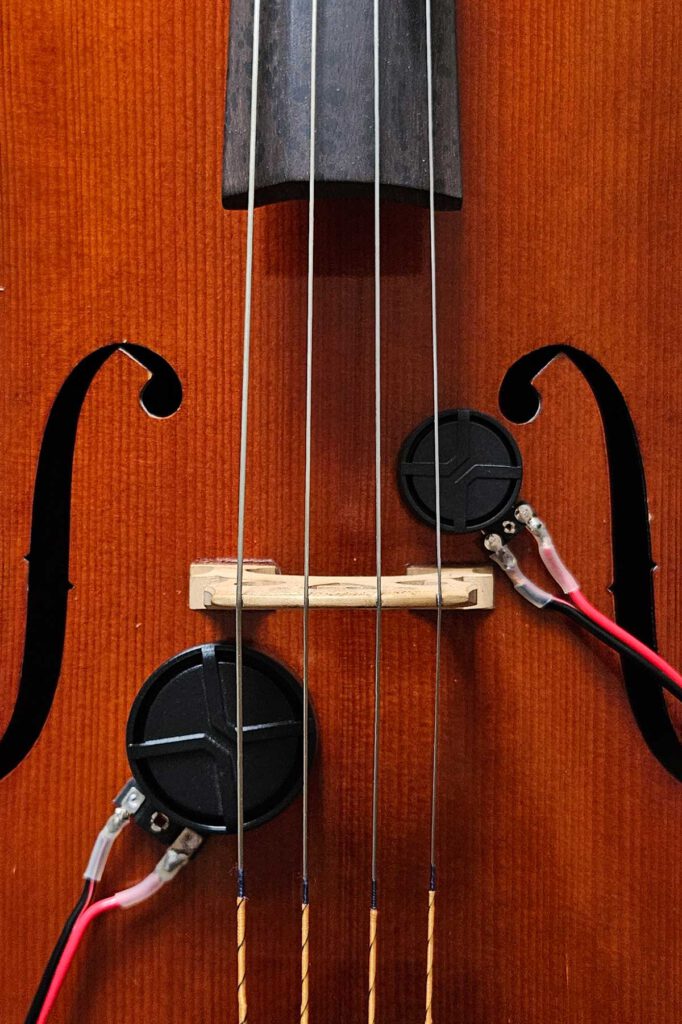
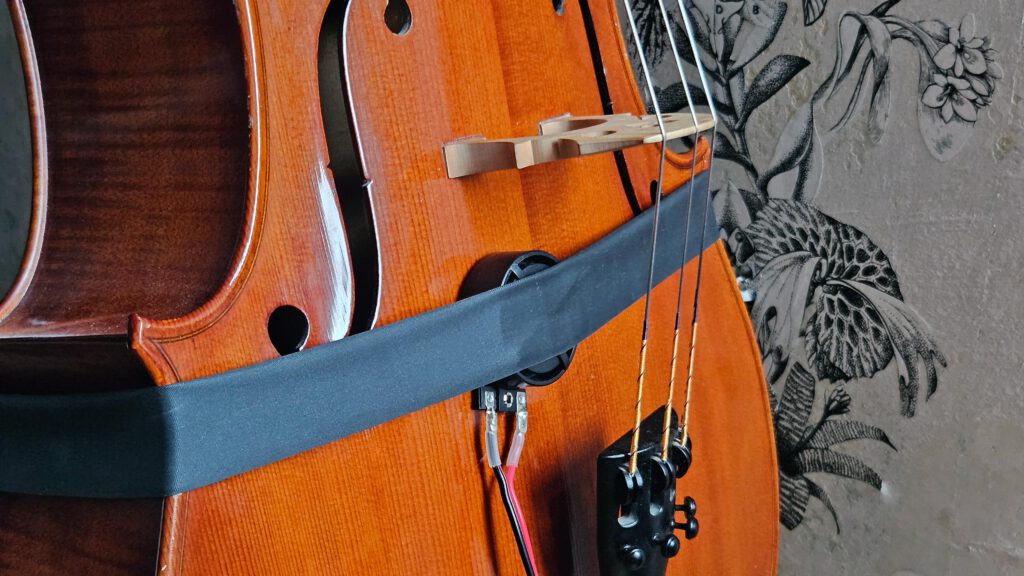
On my cello, I get the most pleasing and balanced result with the XTB40 just below the left bridge foot, on the C- and G-string side, and the XT25 just above the right foot, on the D- and A-string side. These positions roughly follow both the arrangement of the lower and higher strings and the construction of the cello—with the bass bar running beneath the area where I place the XTB40, for example. The resulting diagonally offset positioning of the exciters is also consistent with placement suggestions I’ve come across in exciter manufacturers’ guides and on DIY audio community websites.
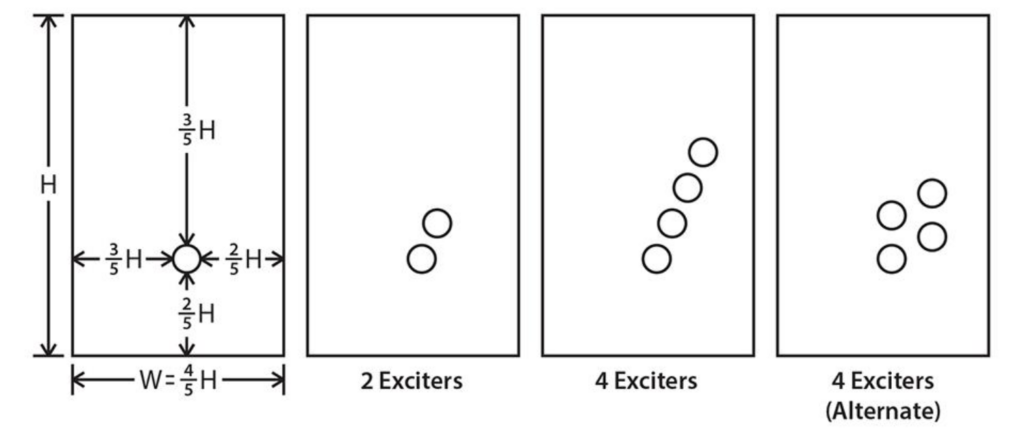
Depending on the sound I’m after, I also try other positions. Moving an exciter makes a surprisingly large difference and offers plenty of scope for shaping the sound.
Attaching the exciters
The exciters come with an adhesive mounting surface. Alternatively, mounting rings are available that can be screwed into place. Both methods probably hold very well, but neither was quite what I had in mind for my cello! 😉
My workaround to avoid scratching my cello or drilling holes in it is to use resistance bands of the kind normally used for Pilates. They provide enough tension to hold the exciters in place and make it easy to attach, reposition or remove them.
The sound source
My original idea was to perform my compositions for two cellos on my own, with an extra “ghost hand” helping out. So I started looking for a suitable cello sound to feed into the exciters.
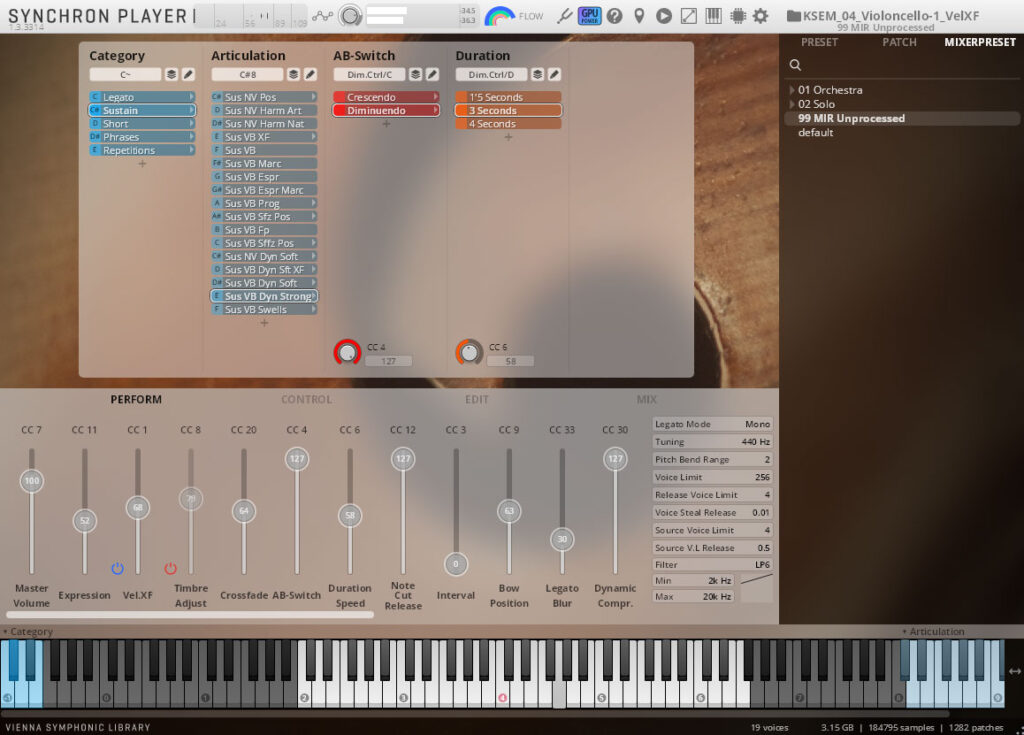
First, I tried libraries with solo cello sounds, such as Abbey Road Two by Spitfire Audio, Studio Solo Strings by Vienna Symphonic Library (VSL), and Berlin Solo Strings by Orchestral Tools.
It quickly became clear that, for the effect I wanted, the source needed to be as dry as possible, without recorded or added reverb. It sounds quite strange when a small cello appears to contain the reverberation of a whole room! With VSL’s Studio Solo Strings, for example, I selected the MIR Unprocessed mixer preset to get a dry starting point. That already sounded very convincing.
Since then, however, I have moved away from sample libraries for this particular purpose and bought SWAM Cello by Audio Modeling. It generates sound through physical modelling rather than playing back microphone recordings. With its reverb switched off, it gives me the very dry source I need.
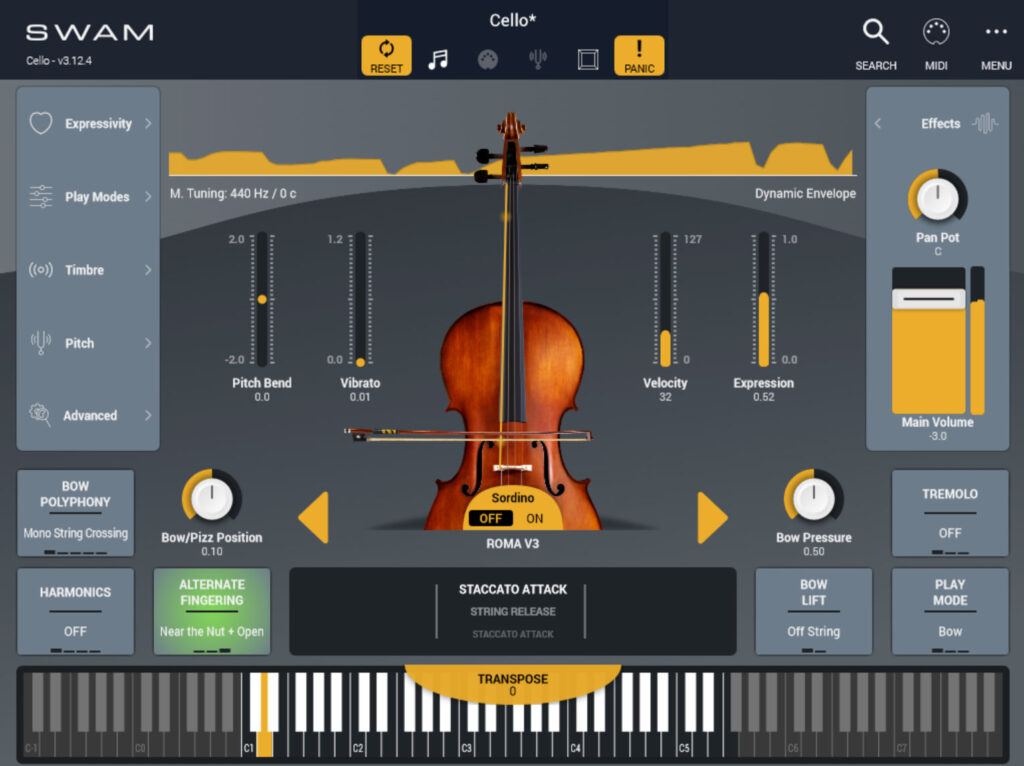
Besides finding it the most suitable cello sound for this project, I also enjoy the idea itself: a computer-generated cello acquiring a real wooden body.
Connecting and powering the exciters
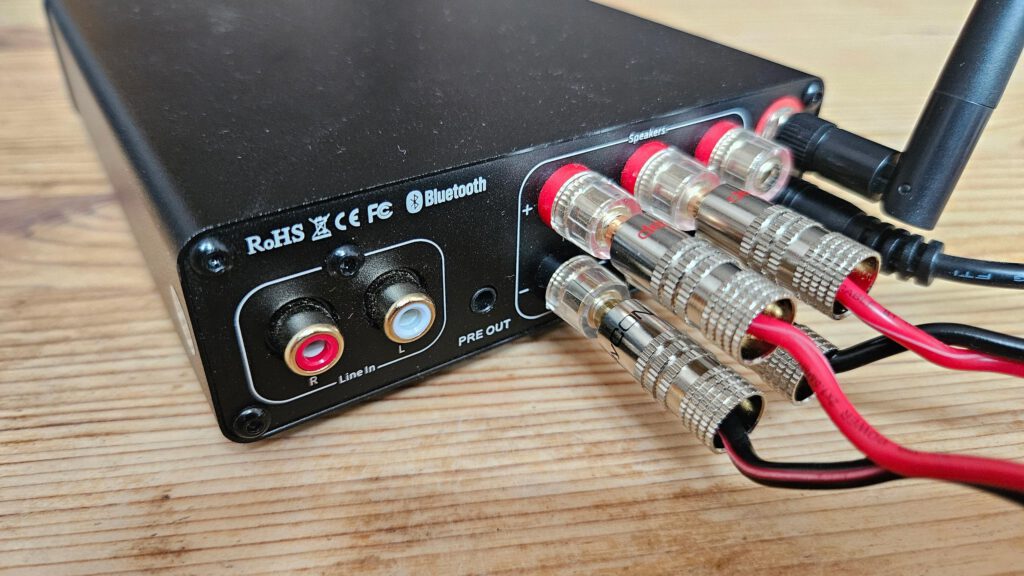
Finally, how do the exciters actually receive their signal? They connect to an amplifier just like passive loudspeakers. To keep the setup portable and avoid carrying a bulky amplifier alongside my cello, I bought this little Fosi Audio BT30D Pro 2.1. I also fitted banana plugs to the speaker cables, saving me from fiddling with bare wire in a potentially dark concert venue and making it easy to change connections.
Overall, I’m very happy with the amplifier. For such a small unit, it has plenty of power for my setup. It gets warm during use, but hasn’t become hot in my experience.
Being able to connect my phone quickly over Bluetooth is convenient too. For concerts, I would stick to a cable to avoid Bluetooth’s lossy audio compression and additional latency, but for practising at home, the wireless connection is handy. Playing the cello already limits your freedom of movement, and with the exciters attached, there are enough cables dangling around as it is.
One reason I chose this model was the option of connecting the XTB40 to the dedicated subwoofer output, allowing me to use three exciters in total. The SUB FREQ control adjusts the subwoofer channel’s low-pass cutoff up to 300 Hz, and its volume can be controlled separately.
That offers some useful flexibility, although a three-exciter setup hasn’t proved particularly practical on my cello, with its limited mounting options. For other sound projects—such as using exciters on wooden objects—I can imagine the extra bass channel being useful for shaping the sound.
If you don’t need the separate subwoofer channel or Bluetooth, a simpler stereo amplifier such as the Fosi Audio TB10D could be a more economical option.
One feature I would have liked is a balance control for adjusting the relative levels of the two exciters, but I didn’t come across any mini amplifiers with one during my research.
If this has sparked your curiosity, you don’t need a cello to start experimenting. A wooden board, an exciter and an old hi-fi amp tucked away in the attic or basement are enough to get started.
I’ve written mostly from a cellist’s perspective, but as a fan of Boards of Canada and their hazy analogue sound, full of tape hiss and gently wavering pitches, I naturally wanted to keep experimenting—for example, by sending sounds from my synths through a wooden board, metal plates and other materials, then recording and sampling the results. I’m curious about how these physical transformations affect our perception of sound—the same curiosity that makes me interested in experimenting with alternative tunings such as A = 432 Hz.
If you fancy trying a little “sonic homeopathy” in your own productions—or simply turning your bed, table or wardrobe into a speaker—these two guides are a good place to start exploring exciters.
A Basic Guide to Creating Invisible Sound with Exciters — SoundImports
Exciter Buyer’s Guide — Dayton Audio
I started out looking for a ghostly second cellist—and ended up listening to the furniture at home. And whenever I’m out walking in the woods and pass an old tree stump with its beautifully shaped roots still attached, I find myself wondering what a wonderful speaker it might make. 😉