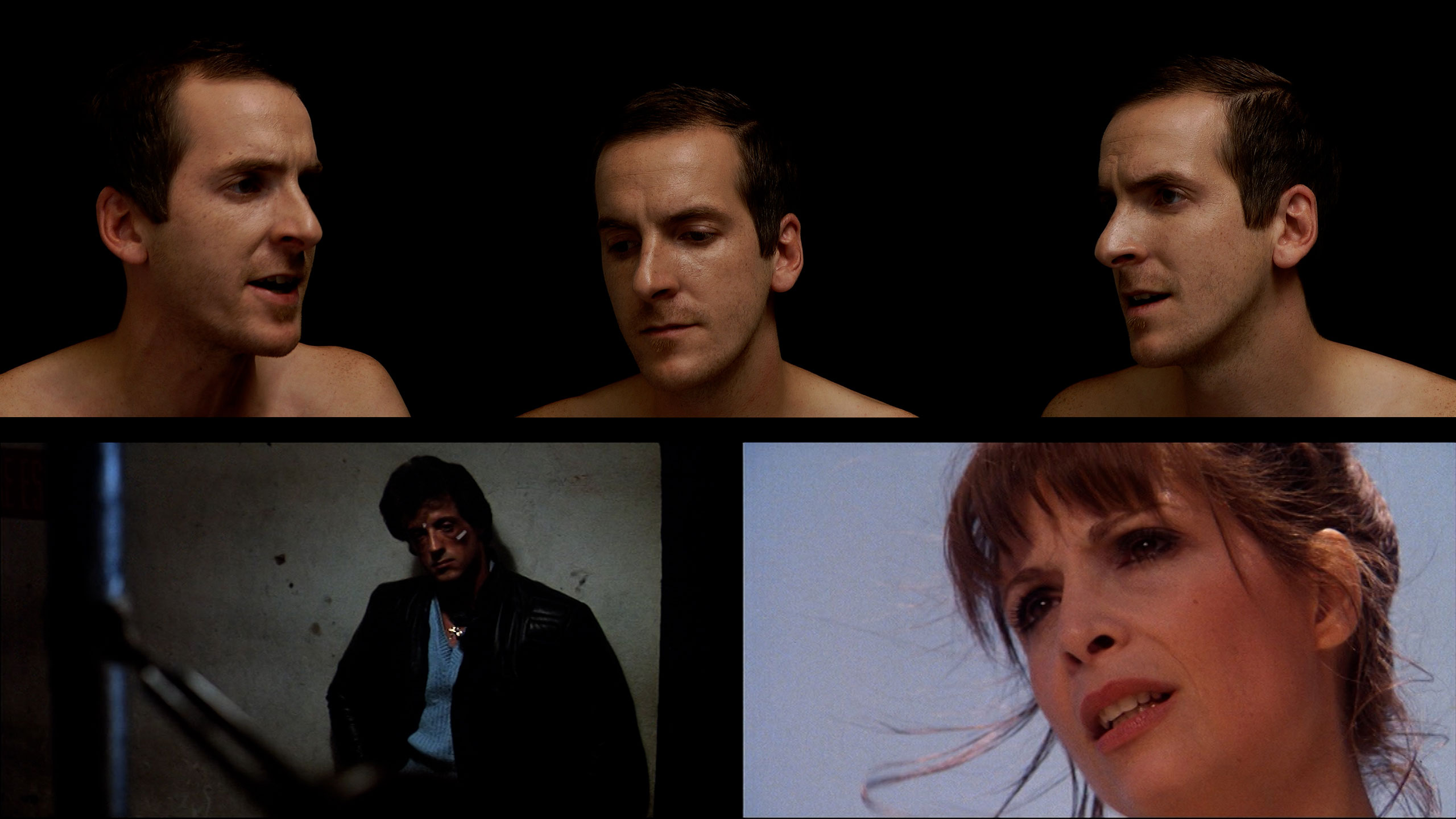
Click the play button above to watch the video.
For an English translation, you can switch the audio track to hear the original film dialogue.
The first project on this website, Yo Adrian, I did it!, was also my graduation project for the Master of Fine Arts at Kunsthochschule Kassel. It explores masculinity—and what happens when familiar roles no longer quite fit.
I think most men of my generation support women’s emancipation. But agreeing that women should be free to redefine their roles does not necessarily mean we have reconsidered our own. Have we been more willing to applaud change than to take part in it?
The work also draws on a fascination I have had since my teenage years: dubbing. I still find it remarkable that, at the touch of a button on a remote control, people in films can suddenly speak another language. For a moment, linguistic borders seem to disappear. Everyone understands each other.
Only occasionally does the illusion slip: a mouth moves slightly out of sync with the words we hear, and something feels wrong. The person is still convincing—but perhaps a little less trustworthy? Or perhaps just unsure of himself?
Already in my very first video work at art school, I deliberately used this discrepancy to make viewers question what they were seeing and hearing. In Yo Adrian, I did it!, dubbing becomes a way of stepping into someone else’s role, borrowing his words and trying his masculinity on for size to explore a more important question: what do I want, and how can I define my own role as a man and free myself from traditional expectations if, like women, I no longer have to follow an inherited script?
5-Channel Video Installation
4k / 3:37 min / German
Germany / Netherlands, 2011
Supported by TENT Rotterdam (NL)
Sources
Rocky II
Written and directed by Sylvester Stallone
© 1979 Chartoff-Winkler Productions / United Artists
Rocky III
Written and directed by Sylvester Stallone
© 1982 Chartoff-Winkler Productions / United Artists
Rocky IV
Written and directed by Sylvester Stallone
© 1985 Chartoff-Winkler Productions / Metro-Goldwyn-Mayer (MGM) / United Artists
Catalogue Text
Below is a catalogue text about the work, written by Bernhard Balkenhol for the Monitoring exhibition at the Kassel Documentary Film and Video Festival in November 2011.
It is as if Rocky lives through his (five-film) life(s) all over again and resumes his fights in front of the mirror. Jan Bode performs a resigned, almost desperate drama of explanation, not about the fights in the boxing ring, but about the fights that led him to the boxing ring. “I just gotta do what I gotta do,” he states at the end of the first epilogue. Rocky has a mission, a calling. He will have succeeded when he says: “Yo, Adrian, I did it!”
The video installation by Jan Bode is based on the film series Rocky Balboa (1976 / 79 / 82 / 85 / 90). Rocky is the main character. Jan Bode performs his character on the middle screen. Adrian Pennino Balboa, his wife, Apollo Creed in the role of his former rival, who is now his coach, as well as his challenger James “Clubber” Lang talk insistently, sometimes simultaneously, to Rocky from the left and right screens. Jan Bode plays the various roles and, by doing so, shows how much Rocky carries his own role as well as the other roles within himself. At the end of the fifth epilogue, does he have to realize that he is alone and will remain so? “Just you alone.”
The scenes Jan Bode chose are not a compressed summary of the films, but reflect the hero’s search for identity and his gender role as a man in modern society. The artist reflects on how the media stages this role and why an emancipated society approves of it. Is the role of the man as presented in the media up to date? It has been a long time since a man was expected to be tough, competitive and able to put on a poker face. The new man should be a lot different. Or should he?
The characters argue with a militant commitment. It seems as if he is preparing himself for something. At the same time, the internal dialogue wears him out when he feels and admits that he is afraid, when he has to accept that he has lost: “I’m supposed to be a fighter.” But his self-complacency, which shines through repeatedly, makes us see the tragedy and helplessness of his fight and proves him right. “We have to be right in the middle of the action. We can’t change what we are. And all we can do is just go with what we are.”
What is this fight about? It is neither material nor domestic success, nor success with the public, that Rocky tries to achieve and that defines and satisfies him. It is about assertiveness and an imaginary victory over himself that was full of effort and pain. It is the triumph over an allegedly better man.
“But that don’t change a thing. We’re born with a killer instinct. That you can’t just turn off and on like some radio. We have to be right in the middle of the action. Because we’re the warriors.” And there it is again: the man as a man is left to his own fate. And therefore the hamster wheel of self-justification keeps on spinning, just like the loop of this monologue, which blurs beginning and end. We lose track of where this will all end. Or do we? “Adrian, a lot of people don’t have a choice. I do.”
Text: Bernhard Balkenhol