This little corner of the website came about by accident. I’d written a social media post that exceeded the 500-character limit, so I couldn’t publish it. Rather than leave it homeless, I gave it a place here. Since then, thoughts on various subjects have been appearing at regularly irregular intervals.
This time, it’s about immersive sound, and there are 6,183 characters waiting to be read. If that number hasn’t scared you off, make yourself a coffee, sit back and enjoy.
Immersive Sound:
What Are We Listening For?
About ten years ago, I saw a lot of audiovisual performances, both as a spectator and as a festival jury member. This was a time when generative visuals, created through programmed algorithms and often audio-reactive, were becoming increasingly common. Performers were moving away from the familiar looped samples, manually triggered to the beat on a MIDI controller and mixed with effects.
What I often found disappointing was that many of these performances never really went beyond the technology itself and seemed to be little more than showcases for the code behind them. For the first five minutes, you think, “Wow, that looks amazing!” After ten minutes, you start wondering whether there is anything more to come. Another ten minutes later, you begin shifting restlessly in your seat. And after half an hour, you slowly start to feel that you’re being robbed of time from your life. Occasionally, you even get annoyed at being trapped in the audience, too polite to disturb the performer and everyone else in the room by awkwardly squeezing your way out along the row. My thought was always: “Your visuals are fantastic, but what are you trying to tell us? And if you have no particular message—which would be perfectly fine too—have you at least given some thought to how the performance unfolds? Perhaps a little dramaturgy might help?”
To my mind, that development is somewhat comparable to what is happening with immersive sound today. Here, too, advances in technology, more affordable hardware and increasingly powerful computers are making the tools—and immersive shows themselves—more widely accessible. That’s welcome, but it also carries the risk of technology taking centre stage at the expense of the music or composition. Or “immersive” becomes just another marketing buzzword, adding little to the audience’s experience. When the experience fails to live up to the promise, fascination can quickly give way to disappointment.
Of course, an experience centred on the technology itself can also be perfectly legitimate and deserves a place of its own. An immersive sound experience might be the modern equivalent of a roller-coaster ride at an amusement park in the 1980s. People have always craved adventure and excitement. But a roller-coaster ride is short, and even its layout is a kind of choreography, carefully considered by its designers. You don’t head straight into the biggest loop, and the ride doesn’t last thirty minutes either. Otherwise, the passengers will eventually either be sick or start getting used to the feeling of 3G as they go around the loop… and get bored.
And what about wellness or medical settings? As with an exercise ECG on a bike at the doctor’s, the intensity needs to be carefully paced—the test doesn’t start at full intensity and leave you discouraged and gasping for breath right from the start. An immersive sound experience in that context will have an arc, too. The sound might gradually become slower and calmer, then grow more active towards the end to wake the patient up again.
So, amid all our enthusiasm for the technology, we should remember both the artistic content and the basic principles of a good show. To make my point a little clearer, let’s simplify the technology and imagine a lighting technician controlling an RGB light via DMX. They wouldn’t leave red, green and blue on at full intensity throughout the show. That combination would give us a bright white light on stage. Instead, they would use individual colours to create an atmosphere, complement the music and heighten emotions. Sometimes they would even dim the light right down, making our eyes more sensitive to the blinding white light that then flashes at the show’s climactic moments. Otherwise, they might have chosen the wrong profession and would perhaps be better suited to making light bulbs.
Sorry, that may have sounded a little unkind. It wasn’t meant that way. I worked as a technician myself for many years and have enormous respect for the profession. Where would humanity be without technicians, scientists, programmers and inventors whose curiosity, ideas and imagination have brought new things into existence? People with a vision who, sometimes almost obsessively, poured their time and energy into something that had previously been impossible. People who reached the limits of what could be done in their time and, through ingenuity and improvisation, stretched them and ultimately pushed them further.
I think artists and technicians have a great deal in common. Both pursue a vision, bringing passion and idealism to their work. And when they develop their ideas together, they can create an experience neither could have achieved alone. Take two examples from cinema. In Psycho, the interplay between Hitchcock’s images and Bernard Herrmann’s score can even make the audience scream in fear before the woman in the shower herself does. For Kubrick’s 2001, visual effects specialist Douglas Trumbull developed a technique that made the famous Stargate sequence possible, giving visual form to Kubrick’s imagined journey into the unknown.
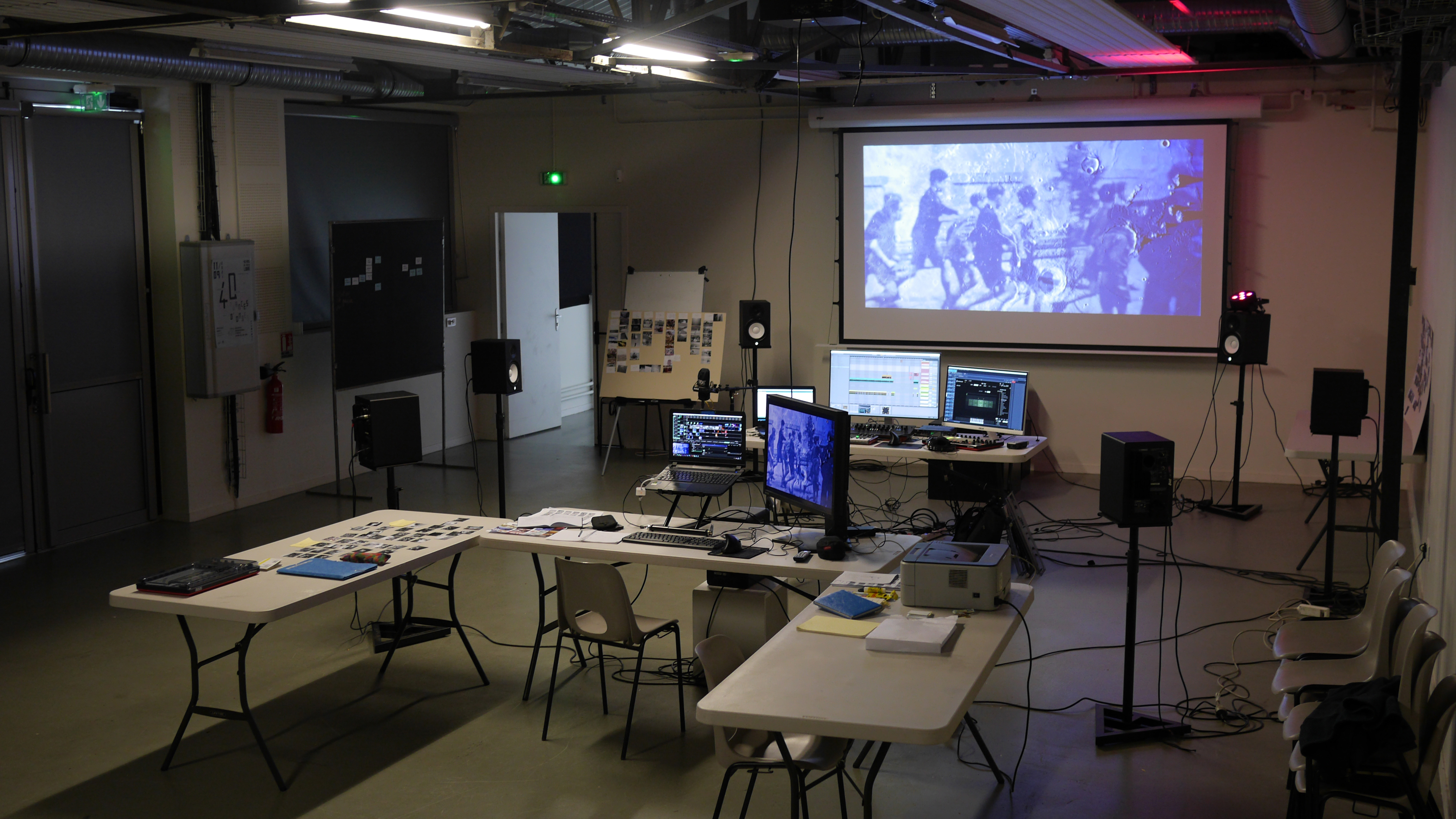
I have only worked with multichannel sound once myself, in a theatre. I had eight speakers positioned around the audience. The trick was that, at first, the audience didn’t know they were there. At one point, I made a mobile phone ring twice in quick succession in the back rows. I admit it’s an old and slightly worn-out theatre trick. But there was a reason for it. The poor presenter on stage was already struggling to stay focused because of an increasingly cheeky AI co-moderator, and these additional interruptions were meant to earn him a little sympathy. Despite the AI’s really funny comments and jokes, we wanted the audience to be on his side. It was a dramaturgical decision.
I then used a hypnotic sound circling the audience to send them into hibernation so they could survive an imaginary journey through space. Later, chunks of rock struck the spaceship and sometimes scraped slowly along its outer hull, with the sound travelling all the way from the front to the rear speakers.
After the show, a colleague’s kid, who had been in the audience, told me they had felt a little frightened at that moment. That was a wonderful compliment. We had managed to use sound technology to imitate reality and create an illusion. Of course, everyone in the audience knew they weren’t flying through space in a spaceship and hadn’t somehow encountered a meteor shower while sitting in a theatre seat. But the tension and nervousness were still there, just as in a good film—only this time, it was all happening in their imagination.
And imagination is probably the key word. Without it, writers couldn’t write good stories, artists couldn’t paint pictures, and musicians couldn’t compose songs. Inventors, technicians and programmers couldn’t come up with new ideas and solutions. And audiences couldn’t experience these creations with the same enthusiasm.
Technology should be one ingredient. And, as with cooking, the right amount of salt can turn a meal into a culinary experience, while too much can spoil it. Some dishes don’t need any salt at all. They simply taste better without it.